Posted on

Homefarm helps you overcome the limits of winter gardening

Homefarm helps you overcome the limits of winter gardening

For centuries, commercial farmers and home gardeners have planned around and been at the mercy of the seasons. Some crops grow better in the warmer months and others in the cooler months. Some require more rain and others thrive in slightly drier conditions.

Planting and harvesting schedules have been subject to the same cycles and seasonality for as long as we have a record of this activity in civilisation. Entire nations’ cuisines and eating patterns have been shaped and formed by their unique climates and annual seasons.

Industrialisation and globalisation have redefined farming operations

Globalisation and modern consumer demands have seen markets find ways of supplying exotic (non-indigenous) and out-of-season produce. Fruit and vegetables are shipped across long distances, often to completely different climatic zones from where they were grown, and commercial farmers have found innovative ways of growing crops out of traditional seasons.

Commercial farmers are using climate controlled tunnels and greenhouses to grow crops like berries, peppers and leafy produce in winter. Carefully selected seed varieties can also assist in yielding produce during the colder months. Some of these practices are more environmentally friendly than others, but they’ve made consumers and households fairly used to consistent availability of their favourite foods all year round.

What about microscale farming and home-based gardens?

Environmentally conscious home/hobby gardeners and small scale farmers/agribusinesses, who lack the resources to grow certain produce during winter, have resorted to abandoning their outdoor gardens because it costs too much and takes too much effort to keep them alive during winter.

They wait for the opportunity to replant and revive their vegetable gardens in the spring.

How is Homefarm helping overcome seasonal limitations?

Thanks to our Homefarm systems, there is now a way for home gardeners and small businesses to access the tools they need to successfully grow more of their leafy produce in winter. By moving their herb gardens indoors, and using a Homefarm system, they can better regulate the temperature of their garden and enjoy yields throughout the year.

What’s more, they can get ahead of their early spring outdoor planting schedule by using a Homefarm system as a nursery to propagate fruit and veggie seedlings ahead of time. 

Depending on how you plan your produce or what your volume demand is for seedlings, there will be a Homefarm system to suit you.

Our current range allows you to grow anywhere from 500g-15kg per month. Our largest system can also produce up to 3500 seedlings per month.

Key advantages of using a Homefarm system for home food gardening

    • Winter food gardening and farming

      Move your operation indoors during the winter months and sustain your family, community or business with fresh produce all year round.

    • Supplement your outdoor garden

      Increase the variety of crops you grow all year round. Grow fresh produce such as herbs, microgreens and lettuces, which thrive in an indoor or sheltered space. 

    Use your Homefarm to propagate seedlings and get ahead of your regular planting schedule each year.

    • Organic and fully automated 

    Indoor-grown Homefarm crops can be grown organically because of our soil-based hydroponics systems. It’s a more natural environment that helps your crops thrive from Day 1. Automated watering and supplementary lighting cycles eliminate most of the work related to a traditional outdoor food garden.

    • Loadshedding-friendly

    Homefarm systems have been designed, developed and tested in South Africa. They are built to withstand the challenges of loadshedding, and incorporate a range of features which protect your crops from frequent power outages.*

    *All systems automatically accommodate for loadshedding in relation to lighting and irrigation cycles; built-in surge protection is currently only available for Appliance and Commercial systems. For more information, please speak directly with a Homefarm consultant.

And last but not least — the all-important cost benefit

Homefarm systems enable you to grow produce at wholesale price or less. Our largest Homefarm Commercial system enables you to grow up to 15kg of produce for as little as R2000 per month in total input costs. If your business or community uses fresh leafy produce, Homefarm is a system you should consider.

Winter-worthy microgreens recipes

While you’re mulling over your decision, try these tantalising microgreens recipes.

If you’re struggling to source microgreens this winter, perhaps it’s time to find the right Homefarm system for you.

Sour dough toast avo and microgreens – enjoy a fresh and light meal – perfect for your lunch or supper.

Carrot microgreen salad – this dish just pops with colour.

Enjoy making these delicious dishes this winter.

References:

Carey, H. 8 Undeniable Reasons We Should All Be Eating Seasonal Foods. Available at: https://munskin.com/blogs/health-wellness/eating-seasonal-foods#:~:text=Eating%20in%20tune%20with%20the,air%20pollution%2C%20and%20global%20warming. (Accessed: 30 April 2023).

Haas, S. (RDN, LDN). (2023). What Is Seasonal Food? Your Complete Guide to Shopping, Growing, and Cooking Seasonally. Available at: https://www.healthline.com/nutrition/seasonal-food. (Accessed: 30 April 2023).

Russo, J. Pros & Cons of Growing Your Own Fruits & Vegetables. Available at: https://www.gardenguides.com/4024456-pros-cons-of-growing-your-own-fruits-vegetables.html. (Accessed: 1 May 2023).

Sourdough Avocado Toast with Microgreens. (2014-2023). Available at: https://afoodloverslife.com/avocado-toast-with-microgreens/. (Accessed: 12 May 2023).

Walthers, C. Carrot and Microgreen Salad. Available at: https://www.edibleboston.com/blog/2020/2/1/carrot-and-microgreen-salad?format=amp. (Accessed: 12 May 2023).

WebMD Editorial Contributors. (2005-2023). What to Know About Seasonal Eating. Available at: https://www.webmd.com/diet/what-to-know-seasonal-eating. (Accessed: 30 April 2023).
Share this article

Get your Homefarm Commercial today!

Posted on

Homefarm systems align with national parks legislation

Homefarm systems align with national parks legislation

Imagine a world where fresh, sustainably grown produce is just a doorstep away, regardless of the constraints imposed by geography or seasonality.

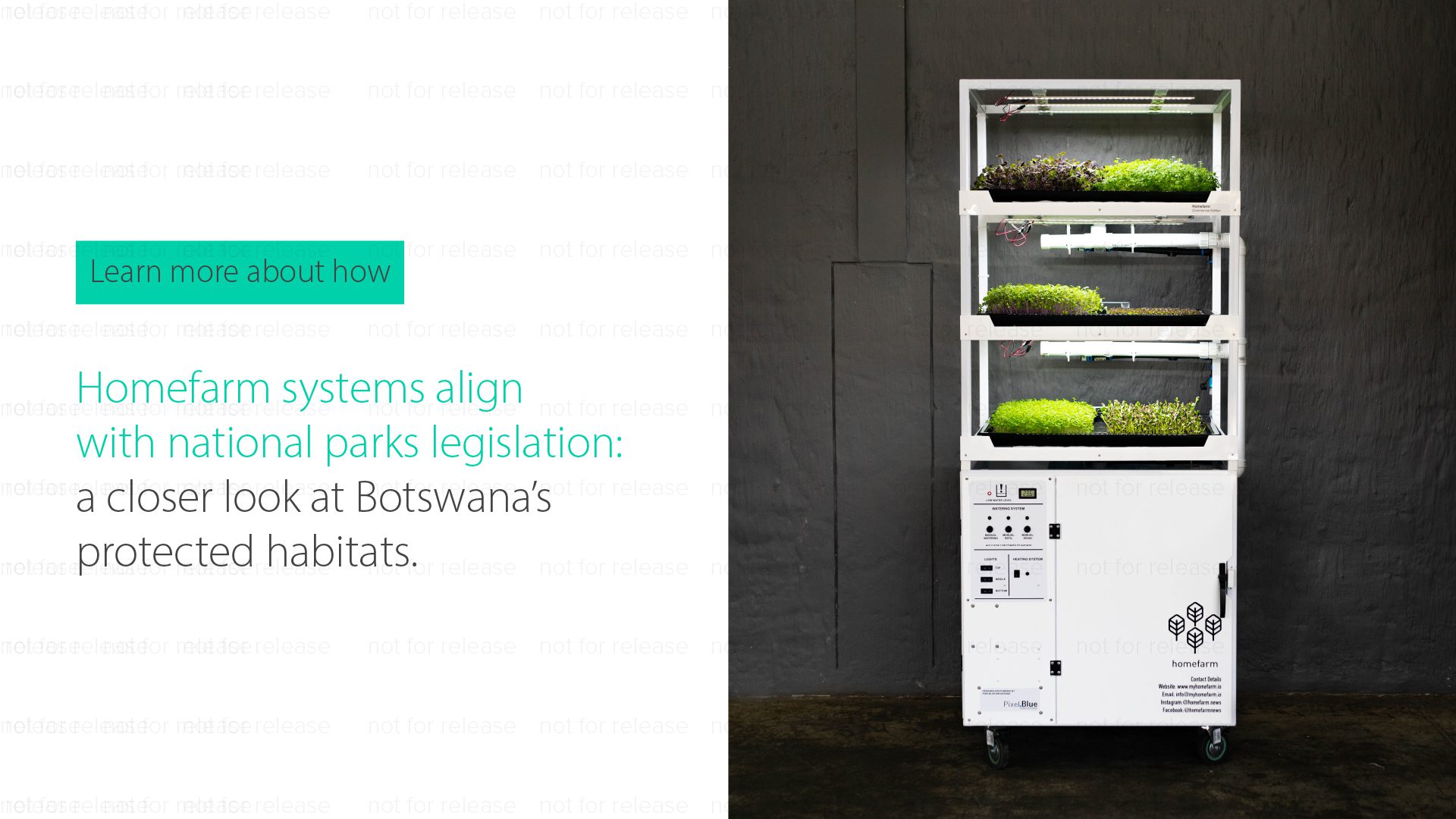
Enter our Homefarm indoor growing systems – a smart-enabled concept that combines technology with plant and soil-based elements. Homefarm Commercial systems, more specifically, are being used to cultivate delicate greens in just about any environment, including remotely located lodges in highly regulated areas, like proclaimed game reserves and national parks.

A closer look at Botswana’s protected habitats

A review of Botswana’s Wildlife Conservation and National Parks Act (1992) and the United Nations compliant Plant Protection Act (2009) indicates that the Homefarm Commercial System can be used to grow delicate greens in protected reserves. The indoor system mitigates against attracting wildlife and crops don’t grow all the way to seed, so they won’t propagate themselves unchecked.

It’s important that regulations can be adhered to in protected natural areas, which is why this article goes into further detail about the way that Homefarm systems achieve this.

What’s actually regulated in a conservation area?

Managing and maintaining protected areas can be a lot more complex than most of us realise.

The use of food crop seeds is severely regulated, as well as growing media. It makes it difficult for the remotely located restaurants (particularly those situated in protected national parks and conservation sites) to develop a sustainable and stable supply of fresh produce by growing anything on site.

Homefarm Commercial complies with conservation regulations

The table below outlines a number of specific regulations within Botswana, and the corresponding features of our Homefarm systems, which highlight our products’ compliance.

It should be noted that regulations and laws referenced in this article relate to outdoor planting of food crops in protected areas, and that no specifications could be found yet for indoor food farming.

Important points to consider

All grow trays should be seeded with caution, despite the process being completed entirely indoors. Seed quantities are proportionate to the size of tray fitted into your Homefarm system, preventing risk of unused seeds germinating outdoors, even if discarded with the balance of commercial kitchen refuse.

Before importing a Homefarm system from South Africa into Botswana, we encourage that you visit your local import office for updated legislation. Should you have any questions, please don’t hesitate to consult one of our friendly experts. Simply use our contact form to get in touch and one of our team members will contact you directly.

Following on from research completed for several clients enquiring from within Botswana’s premium nature reserves, we have confirmed that Homefarm systems are fully compliant with national parks legislation.

References:

Government of Botswana. 2009. Plant protection regulations. Chapter 35:02: Plant protection: subsidiary legislation (index to subsidiary legislation). Available online at: https://faolex.fao.org/docs/pdf/bot126406.pdf [Last accessed: 9 July 2023]


Government of Botswana. 1998. Wildlife conservation and national parks act of 1992. Chapter 38:01: wildlife conservation and national parks. Available online at: https://www.botswanalaws.com/StatutesActpdf/1992Actpdf/WILDLIFE%20CONSERVATION%20AND%20NATIONAL%20PARKS%20ACT,%2028%20OF%201992.pdf [Last accessed: 9 July 2023]

Share this article

Get your Homefarm Commercial today!

Posted on

What’s the nutritional value of Homefarm crops?

Nutritional Value of Homefarm crops

Do you want to start growing delicious microgreens, leafy greens and herbs? Look no further than Homefarm, the indoor farming technology pioneer.

Homefarm systems enable people to make healthier lifestyle choices every day.

  • Homefarm systems are smart, fully automated indoor farms that can grow a wide range of crops from seed to harvest, year round. 

  • The Homefarm Appliance and Nano are perfect for hobby gardeners, health and wellness gurus and passionate foodies. 

  • The Homefarm Nano is designed for smaller kitchens and is ideal for growing leafy greens at home. 

  • The Homefarm Appliance can either be proudly displayed on a countertop or built into your kitchen cabinetry. Wow your family with delicious meals with greens harvested in your Homefarm system.

  • Homefarm Commercial systems are ideal for restaurants, food retailers, educational institutions, catering companies and corporate cafeterias.

Let’s explore the uses, benefits and nutritional value of some of the crops that can be grown in Homefarm systems.

  • These tasty shoots are sweet, with an earthy aftertaste that makes an exciting addition to sandwiches, wraps and salads.

  • Red Swiss chard contains vitamins A, B, C, E, and K, calcium, magnesium, potassium, iron and zinc.

  • Red Swiss chard microgreens are best eaten as a young plant before the first set of true leaves appear.

Nutritional value of Red Swiss Chard

100g of raw red Swiss chard contains:

Read our Note and Disclaimer at the end of the article on the Nutritional value of Red Swiss Chard.

Uses of Red Swiss Chard

Red Swiss chard has a beautiful earthy flavour reminiscent of a young mild beetroot leaf. Add Red Swiss Chard to a Potato salad or use it to garnish a soup, leafy salad or piece of steak. Its striking colours will elevate the visual appeal of any plate of food and when paired correctly, its earthy tones will enhance, highlight and elevate the flavours of a dish.

  • Basil is a sweet-tasting aromatic herb that has a scent of pepper, anise and mint.

  • Basil is used in Mediterranean and Italian cuisines. 

  • It adds a distinctive flavour to salads, pasta and pizza.

  • Basil has anti-bacterial and anti-inflammatory properties. 

  • It boosts your immune system and strengthens blood vessels.

Nutritional value of Basil

100g of raw basil contains:

Read our Note and Disclaimer at the end of the article on the Nutritional value of Basil.

Uses of Basil

Basil is the undisputed king of herbs. It is used extensively in italian and thai cuisine. It pairs beautifully with tomato whether it be in pasta sauces or on a caprese sald and its sweet aromatic nature makes it a common ingredient in thai curries too. The Homefarm system grows a variety of different types of basil including green basil, purple basil and lemon basil.

  • Kale microgreens is high in fibre and water; these assist in promoting a healthy digestive tract.

  • Kale microgreens contains vitamin C, vitamin E, beta-carotene and zinc.

  • Kale microgreens also contains lutein and zeaxanthin, which may assist in decreasing the risk of age-related macular degeneration.

  • You can add kale to savoury dishes, salads and smoothies.

Nutritional value of Kale microgreens

100g of boiled kale contains:

Read our Note and Disclaimer at the end of the article on the Nutritional value of Basil.

Uses of Kale Microgreens

Kale is considered a superfood and has a very high concentration of anti-oxidants and vitamin C. Kale is a member of the cabbage family and its microgreen has a mild cabbage flavour and is not bitter like its fully grown counterpart. It can be used as a classic microgreen garnish or it can be used as a superfood boost in your favourite smoothie. A great smoothie recipe includes green apple, kiwifruit,  kale microgreens, a squeeze of lime juice and a couple tablespoons of plain yoghurt. 

We hope you enjoy creating delicious dishes from these crops, grown and harvested in your very own Homefarm system.

References:

Dolson, L. (2023). Swiss Chard Nutrition Information and Health Benefits. Available at: https://www.verywellfit.com/carbohydrate-information-for-chard-2241830. (Accessed: 4 June 2023). 

U.S. DEPARTMENT OF AGRICULTURE. Basil, fresh. Available at: https://fdc.nal.usda.gov/fdc-app.html#/food-details/172232/nutrients. (Accessed: 6 June 2023). 

Ware, M. (RDN, L.D.). 2023. What are the health benefits of kale? Available at: https://www.medicalnewstoday.com/articles/270435. (Accessed: 7 June 2023).

Note: The information provided is intended for general informational purposes only.Full disclaimer: 

The information provided is intended for general informational purposes only. It is not intended as a substitute for professional medical advice, diagnosis, or treatment. Always seek the advice of your physician or other qualified health provider with any questions you may have regarding a medical condition or dietary requirements.

Share this article

Get your Homefarm Appliance today!